
Treat a star-only rating as a complete but limited signal
A Google rating with no written comment is still customer feedback. It tells the business how many stars the reviewer selected, but it does not explain the visit, product, employee, date, problem or reason behind the score. The safest response starts by respecting that limit. Acknowledge the rating and avoid filling the silence with a story the reviewer never told.
That distinction matters because a public reply becomes part of the Business Profile. Future customers can read it, the reviewer may be notified, and the reviewer can later edit the original review. Google says approved replies appear publicly under the review and that customers can change their review after reading a response. Write for both audiences: the individual reviewer and the next person evaluating the business.
Do not delay indefinitely while waiting for context that may never arrive. A short response can show that the business monitors feedback without pretending it understands more than the star count. The goal is not to extract a compliment, defend the business or ask for a higher rating. The goal is to make the public record calm, accurate and appropriately useful.
Separate what you know from what you can only infer
Before drafting, make two mental columns. The known column contains the star rating, the fact that the review is attached to the selected business location and whether a business reply already exists. The unknown column contains everything else: what the customer bought, who served them, what happened, whether they were satisfied with a particular detail and whether the rating was accidental.
A five-star rating does not prove the reviewer loved a specific service. A one-star rating does not prove there was a long wait, billing problem or rude interaction. Even seemingly harmless phrases such as “We are glad you enjoyed your meal” can be inaccurate when the profile belongs to a restaurant with takeout, catering and events. Use language that fits the rating itself: “Thank you for the five-star rating” is grounded; “Thank you for celebrating your anniversary with us” is not.
This rule also protects privacy. Do not search reservations, patient schedules or purchase records and then reveal a match in the public response. A reviewer may use a different display name, may be posting for another person or may not expect a business to connect a public rating to a private record. If follow-up requires account details, invite a private conversation through a verified business channel without publishing those details.
Use a three-part reply framework
A reliable star-only reply has three possible parts: acknowledge the rating, express an appropriate response and offer a next step only when it adds value. For a high rating, the first two parts may be enough. For a low rating, a private contact route can help the customer share context. For a middle rating, invite feedback without suggesting that the customer owes the business an explanation.
Keep the wording proportional to the information provided. A rating-only review usually needs one to three sentences. Long corporate statements can make a simple acknowledgment feel automated or defensive. Avoid a list of services, promotional claims, location keywords and calls to buy again. The reply should sound like a business response, not a search-engine paragraph.
Use a real team voice that can be maintained over time. Decide whether replies end with the business name, a department or no signature. If several employees respond, provide a short style guide for greeting, tone, privacy and escalation. Consistency helps; identical copy pasted across dozens of ratings does not. Vary the natural wording while preserving the same factual boundaries.
Match the response to the star level without overreading it
For four- or five-star ratings, thank the reviewer for the rating and welcome them back in a restrained way. A grounded example is: “Thank you for the five-star rating. We appreciate you taking a moment to share it.” You can add “We look forward to serving you again” when that statement suits the business, but do not name an experience the reviewer did not describe.
For a three-star rating, acknowledge the mixed signal and leave space for detail: “Thank you for your rating. If you would like to share what worked and what we could improve, our team is listening.” Do not describe three stars as negative, and do not pressure the reviewer to revise it. A neutral invitation is more useful than guessing which part of the experience fell short.
For one- or two-star ratings, respond calmly and move specific discussion to a private channel: “Thank you for the feedback. We would like to understand your experience; please contact our manager through the phone or email listed on our profile.” If the business has no reliably monitored channel on its profile, fix that operational gap before promising a response. Never claim an investigation, refund or corrective action that has not happened.
Build a safe decision tree for star-only replies
Start with two checks before writing: does the review already have a business reply, and has the rating changed since it entered the queue? If a reply exists, read it before doing anything. Editing can replace the public message, so an employee should not overwrite an owner’s response simply because the item appeared in another tool. If the rating changed, reassess the draft against the current version.
Next, choose the path by rating. High ratings receive a concise thank-you. Middle ratings receive acknowledgment plus an optional invitation to explain. Low ratings receive acknowledgment plus a private contact route. Then apply a privacy check: remove names, appointment details, order details, health information, account numbers and any reference that confirms the person was a customer.
Finally, perform a claims check. Remove statements about what occurred unless the review itself states them and the reply can address them appropriately. Remove promises that the team cannot verify. Confirm the response contains no request to change the score, no incentive and no marketing pitch. The result should still make sense if a future reader sees only the star rating and the reply.

Avoid common reply mistakes
The first mistake is treating silence as permission to personalize. Phrases such as “We are happy you loved the cleaning” or “We apologize for your wait” invent a subject. The second is using a low rating as a public support ticket. Asking the reviewer to publish an order number, room number or appointment date exposes information and creates unnecessary risk. Move case details into a private channel.
The third mistake is bargaining for a better score. Do not offer a discount, refund or gift in exchange for changing or removing a rating. Google’s Maps policy says merchants may not offer incentives for posting, revising or removing reviews, and it prohibits attempts to manipulate ratings. The Federal Trade Commission also addresses sentiment-conditioned review incentives. A service remedy should resolve the customer’s issue, not purchase a public outcome.
The fourth mistake is attacking authenticity in the reply. If a rating appears unrelated, abusive or policy-violating, use the platform’s reporting process and document the reason internally. A public accusation can escalate the situation and may disclose how the business matched records. Keep the public reply professional while the authorized owner follows the separate policy-reporting workflow.
Protect privacy in regulated and sensitive settings
Dental practices, medical offices, legal services, financial services and hotels need extra care because even confirming a relationship may reveal sensitive information. A public response should not confirm an appointment, procedure, stay, case or account. Use language that addresses the rating generally and points to a standard private channel. The customer can decide whether to identify themselves there.
A healthcare business should follow its own legal and compliance guidance before replying. General reply templates are not a substitute for reviewing the privacy rules, professional duties and platform terms that apply to the organization. When the team is unsure, a minimal acknowledgment may be safer than a detailed response. Keep internal investigation notes out of the public reply field.
Apply the same restraint to ordinary local businesses. Do not publish an employee’s full name, customer phone number, email address, loyalty status or payment detail. If the reviewer later adds a comment, revisit the response rather than appending private context. Public transparency means explaining the business’s approach, not exposing the person behind the rating.
Use automation with human review and current data
Automation can help organize unanswered reviews and draft consistent responses, but it should preserve the same factual limits. A draft for a rating without text should acknowledge the rating only. It should not infer a visit type from the business category or add details from a template. A human reviewer remains responsible for tone, privacy, accuracy and whether publication is appropriate.
ReviewDoctor’s connected Google workflow represents rating-only reviews with an empty comment field and instructs its reply generator to acknowledge only the rating. The workflow fetches the review before drafting, checks again before posting, skips an existing reply and rejects a review that changed while the draft was being prepared. It also requires an authorized business connection and records the owner’s publication authorization without logging the original review text as part of this feature.
There is still an operational limit: Google’s reply endpoint updates or creates the reply; it does not provide a conditional create-only operation. A reply added elsewhere between the final check and the write can create a race. If a posting result is uncertain, refresh the live reviews and check Google before trying again. Never repeat a publish request simply because a local screen did not immediately confirm it.
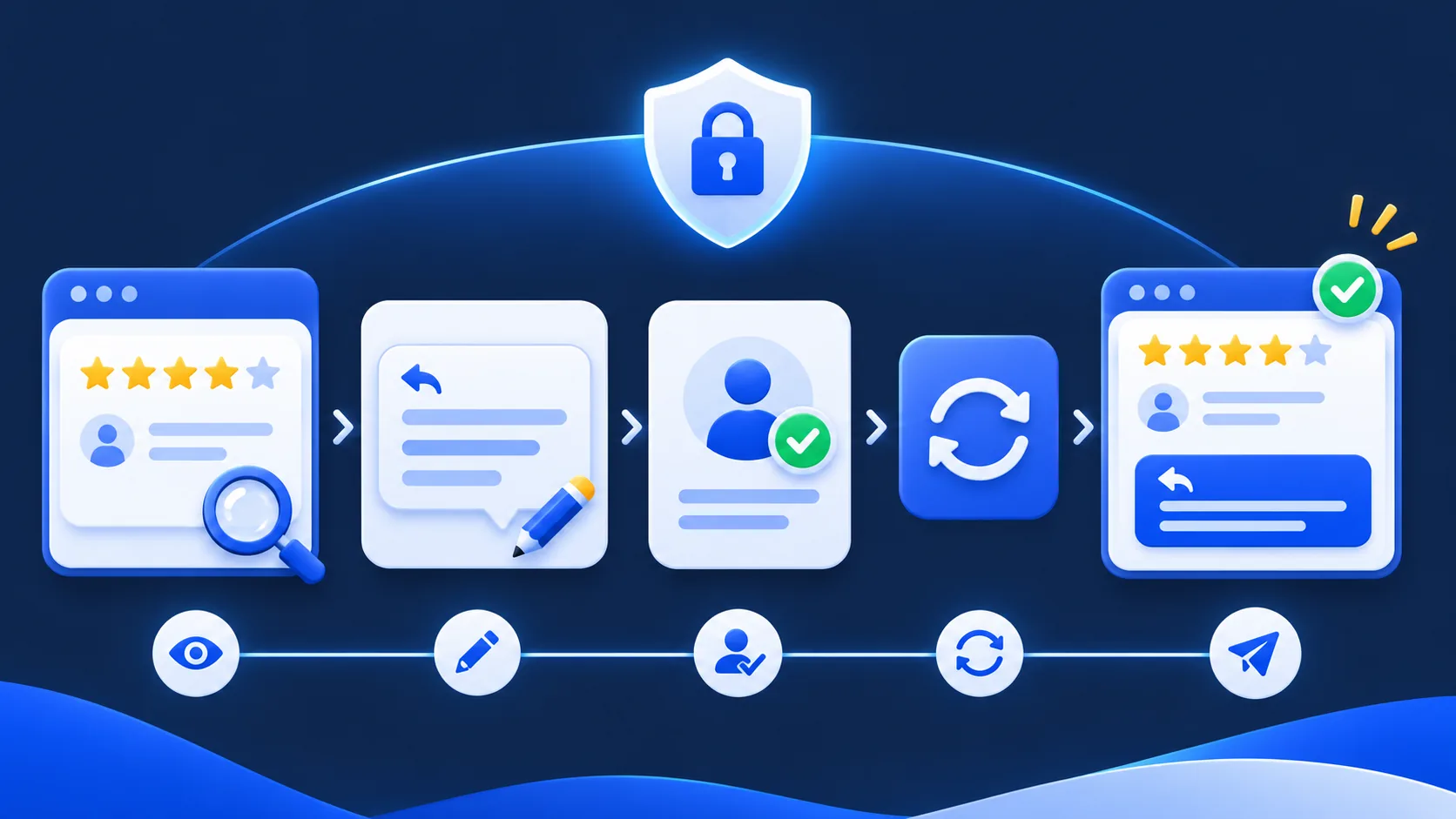
Create a review queue that staff can operate
Assign a clear owner for the queue and a backup for absences. Define which ratings staff may answer, which require a manager and which must go to privacy, legal or safety review. A simple policy might allow trained staff to acknowledge four- and five-star rating-only reviews, route three-star ratings to a supervisor and require owner review for one- and two-star ratings.
Set a reasonable review rhythm. Google notes that replies are reviewed against its content policies and may not appear immediately. Do not post multiple versions because the first is still being processed. Record the review identifier, current rating, reply status and responsible person without copying customer information into unnecessary systems. The queue should make responsibility visible without becoming a second customer database.
Audit a sample regularly. Look for invented details, copy-paste repetition, unmonitored contact instructions, promotional language and promises the business did not fulfill. Review whether escalation paths still match staffing. Update templates when contact channels, ownership or platform policies change. A durable workflow depends more on maintenance than on the first set of sample replies.
Hypothetical walkthrough: a local dental group
Consider a hypothetical three-location dental group. This is an operating example, not a real ReviewDoctor customer case study, and it reports no measured results. The group receives a five-star rating with no comment, a three-star rating with no comment and a one-star rating with no comment. The team does not search patient schedules to identify the reviewers.
The five-star rating receives a short thank-you that mentions only the rating. The three-star rating receives an acknowledgment and an invitation to share more through the office’s published contact channel. The one-star rating is routed to the practice manager, who posts a privacy-safe invitation to contact the office. None of the replies confirms a patient relationship, treatment or appointment.
The manager then reviews the private operations that could need attention using aggregate information and existing internal processes, without linking the public rating to a named patient. If a reviewer chooses to contact the office privately, the team follows its normal identity verification and complaint process. A remedy, if appropriate, is handled independently from the public rating and is never conditioned on changing it.
Use a final pre-publication checklist
Before publishing, confirm that the reply matches the current star rating and that no written comment has appeared. Check that no business reply already exists. Read the response as a stranger would: does it claim a visit detail, reveal private information or imply that the reviewer should change the score? Remove anything that cannot be supported by the visible review.
Confirm the contact route is real, current and monitored. Prefer “the phone number listed on our profile” over publishing a personal employee number. Check spelling, tone and signature. If the reply was drafted with AI, verify every sentence rather than assuming the system understood the context. The person who authorizes publication owns the public result.
After publication, verify the reply appears under the correct review and location. Allow for Google’s review process instead of sending a duplicate. If the reviewer edits the rating or adds text, reassess whether the original response still fits. A good star-only reply is intentionally modest: it acknowledges the customer, protects what is unknown and leaves a responsible path for the conversation to continue.